Mauris euismod rhoncus tortor

Mauris euismod rhoncus tortor

At vero eos et accusamus et iusto odio dignissimos ducimus qui blanditiis praesentium voluptatum deleniti atque corrupti quos dolores et quas molestias excepturi sint occaecati cupiditate non...

Sed nunc augue

Sed nunc augue

At vero eos et accusamus et iusto odio dignissimos ducimus qui blanditiis praesentium voluptatum deleniti atque corrupti quos dolores et quas molestias excepturi sint occaecati cupiditate non...

Why is it needed

Why is it needed

At vero eos et accusamus et iusto odio dignissimos ducimus qui blanditiis praesentium voluptatum deleniti atque corrupti quos dolores et quas molestias excepturi sint occaecati cupiditate non...

Where can I get some

Where can I get some

At vero eos et accusamus et iusto odio dignissimos ducimus qui blanditiis praesentium voluptatum deleniti atque corrupti quos dolores et quas molestias excepturi sint occaecati cupiditate non...

What is Lorem Ipsum?

What is Lorem Ipsum?

At vero eos et accusamus et iusto odio dignissimos ducimus qui blanditiis praesentium voluptatum deleniti atque corrupti quos dolores et quas molestias excepturi sint occaecati cupiditate non...

  • Mauris euismod rhoncus tortor
  • Sed nunc augue
  • Why is it needed
  • Where can I get some
  • What is Lorem Ipsum?
Showing posts with label How it Works. Show all posts

Tuesday, March 16, 2010

Sugar Power For Charging CellPhones

0 comments
Drinking sugary soda gives you a burst of energy. Some day, sugar might power electronic equipment as well.
That's because scientists have now found a way to turn sugar into electricity. If they can find a way to make the technology work on a large scale, you may some day share your sweet drinks with your handheld video game player or cell phone.
A new technological advance could lead to cell phones that are powered by sweet drinks.

The new strategy involves fuel cells, which are devices that use chemical reactions to produce electrical currents. Manufacturers already make fuel cells that depend on precious metals, such as platinum, to spark those chemical reactions. Precious metals, however, are expensive and hard to get.

For the new study, researchers from St. Louis University used a type of protein called enzymes in place of the metals. In the cells of living things, including people, enzymes are what spark chemical reactions. To keep up the pace that our bodies demand, our cells constantly produce new enzymes as the old ones break down.
Scientists had tried using enzymes in fuel cells before, but they had trouble keeping the electricity flowing. That's because, unlike the enzymes in our cells, the enzymes in fuel cells break down faster than they can be replaced.


To get around this problem, the St. Louis researchers invented molecules that wrap around an enzyme and protect it. Inside this molecular pocket, an enzyme can last for months instead of days.
In the new fuel cells, electricity-conducting materials are attached to wires. The scientists coat each conductor with a layer of wrapped enzymes. Then, they allow a sugary liquid to ooze inside the enzyme pockets.
When the enzymes interact with the sugar molecules in the liquid, chemical reactions release a flow of electrons into the wire. This process produces both water and an electrical current that could power electronic devices.
So far, the new fuel cells don't produce much power, but the fact that they work at all is exciting, says Paul Kenis, a chemical engineer at the University of Illinois at Urbana-Champaign.
"Just getting it to work," Kenis says, "is a major accomplishment."

Sugar-eating fuel cells could be an efficient way to make electricity. Sugar is easy to find. And the new fuel cells that run on it are biodegradable, so the technology wouldn't hurt the environment.
The scientists are now trying to use different enzymes that will get more power from sugar molecules. They predict that popular products may be using the new technology in as little as 3 years.—

 See This Article

Do you have any query or doubts,want to know that PLEASE ask it or leave your ideas at comment..or Just mail me:

MAil Me Your Query or Comments::

Friends,If you find anything incorrect here,PLEASE just inform me,to rectifies it !!!!!!!
Read More

Small but mighty Space Telescope WISE

Anyone on Earth can look up and see the moon or stars, but it takes a telescope to get a glimpse of planets and the other bright and strange things that share our universe. Astronomers are always finding new ways to observe far-off galaxies and study the mysteries of deep space.


Wide-field Infrared Survey Explorer project scientist Peter Eisenhardt stands next to the fully assembled satellite.Wide-field Infrared Survey Explorer project scientist Peter Eisenhardt stands next to the fully assembled satellite.


That’s why, on December 14, NASA blasted a small but mighty telescope into space. The telescope is called WISE and is about as wide around as a trashcan. Don’t let its small size fool you: WISE has a powerful digital camera, and it will be taking pictures of some the wildest objects in the known universe, including asteroids, faint stars, blazing galaxies and giant clouds of dust where planets and stars are born.

“I’m very excited because we’re going to be seeing parts of the universe that we haven’t seen before,” Ned Wright told Science News. Wright is the scientist who directs the WISE project, which costs about $320 million.

Since arriving in space, the WISE telescope has been circling the Earth, held by gravity in a polar orbit (this means it crosses close to the north and south poles with each lap). Its camera is pointed outward, away from the Earth, and WISE will snap a picture of a different part of the sky every 11 minutes. After six months it will have taken pictures across the entire sky.

The pictures taken by WISE won’t be like everyday digital photographs, however. WISE stands for “Wide-field Infrared Survey Explorer.” As its name suggests, the WISE camera takes pictures of features that that give off infrared radiation.
Radiation is energy that travels as a wave. Visible light, including the familiar spectrum of light that becomes visible in a rainbow, is an example of radiation. When an ordinary digital camera takes a picture of a tree, for example, it receives the waves of visible light that are reflected off the tree. When these waves enter the camera through the lens, they’re processed by the camera, which then puts the image together. Voilà! We see a tree.
Waves of infrared radiation are longer than waves of visible light, so ordinary digital cameras don’t see them, and neither do the eyes of human beings. But we can feel some types of infrared radiation, in the form of heat.
An artist illustrated WISE in space, along with a depiction of infrared radiation behind it.
JPL/NASA
That’s a key idea to why WISE will be able to see things other telescopes can’t. Not everything in the universe shows up in visible light. Asteroids, for example, are giant rocks that float through space — but they absorb most of the light that reaches them. They don’t reflect light, so they’re difficult to see. But they do give off infrared radiation, so an infrared telescope like WISE will be able to produce images of them. During its mission WISE will take pictures of hundreds of thousands of asteroids.

Brown dwarfs are another kind of deep-space object that will show up in WISE’s pictures. These objects are “failed” stars — which means they are not massive enough to jump start the same kind of reactions that power stars such as the sun. Instead, brown dwarfs simply shrink and cool down. They’re so dim that they’re almost impossible to see with visible light, but in the infrared spectrum they glow.
These are just a few of the wonders that will show up in a gallery of WISE’s greatest photos. During its mission, WISE will take pictures of hundreds of millions of stars, asteroids, galaxies and brown dwarfs. Not bad for a flying trashcan!

POWER WORDS (adapted from the Yahoo! Kids Dictionary)
infrared The range of invisible radiation that extends from the long wavelength, or red, end of the visible-light range to the microwave range. Invisible to the eye, it can be detected as a sensation of warmth on the skin.
radiation Emission and propagation of energy in the form of rays or waves.
asteroids Small celestial bodies that revolve around the sun, usually with orbits lying between Mars and Jupiter. They’re usually between a few and several hundred miles in diameter.
galaxy Any of numerous large-scale aggregates of stars, gas and dust that constitute the universe, containing an average of 100 billion (1011) solar masses and ranging in diameter from 1,500 to 300,000 light-years.
telescope An arrangement of lenses or mirrors or both that gathers visible light, permitting direct observation or photographic recording of distant objects.


Do you have any query or doubts,want to know that PLEASE ask it or leave your ideas at comment..or Just mail me:

MAil Me Your Query or Comments::

Friends,If you find anything incorrect here,PLEASE just inform me,to rectifies it !!!!!!!
Read More

How to make Temperature Sensor

0 comments
A TYPICAL TEMPERATURE SENSOR
V. Ryan © 2005

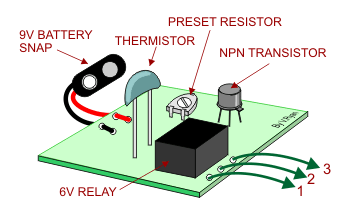
Opposite is a simple temperature sensor. It operates in exactly the same way as a light/dark sensor except that it has a component called a thermistor rather than a LDR (Light Dependent Resistor). The thermistor's resistance value changes when the temperature rises or falls. This ‘triggers’ the relay.The preset resistor allows the person using the circuit to alter its sensitivity to changes in temperature..
When are temperature sensors used?


Do you have any query or doubts,want to know that PLEASE ask it or leave your ideas at comment..or Just mail me:

MAil Me Your Query or Comments::

Friends,If you find anything incorrect here,PLEASE just inform me,to rectifies it !!!!!!!
Read More

Make a light,dark sensor by yourself

0 comments
 MAKING A LIGHT / DARK SENSOR


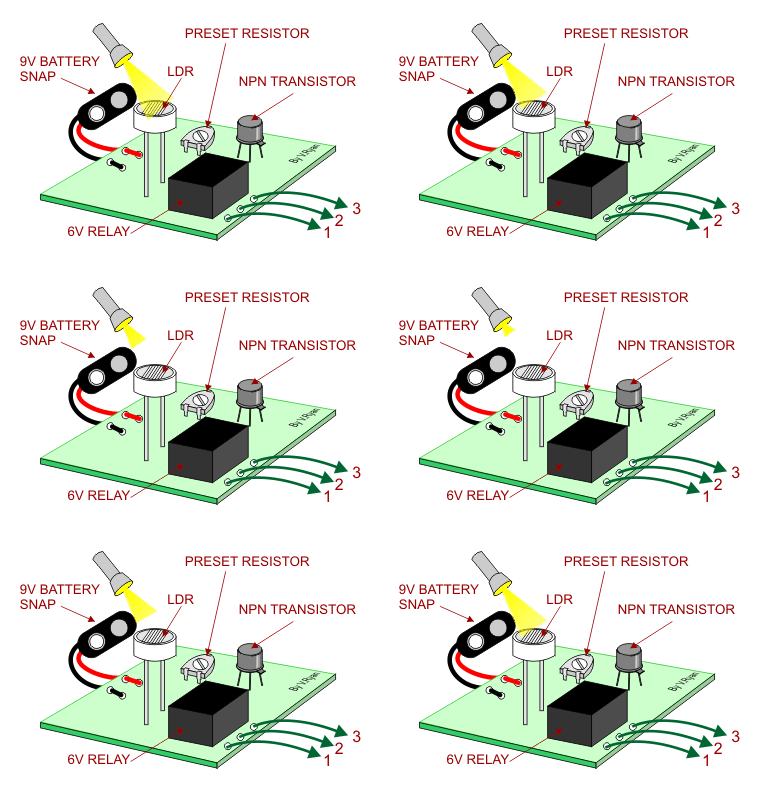
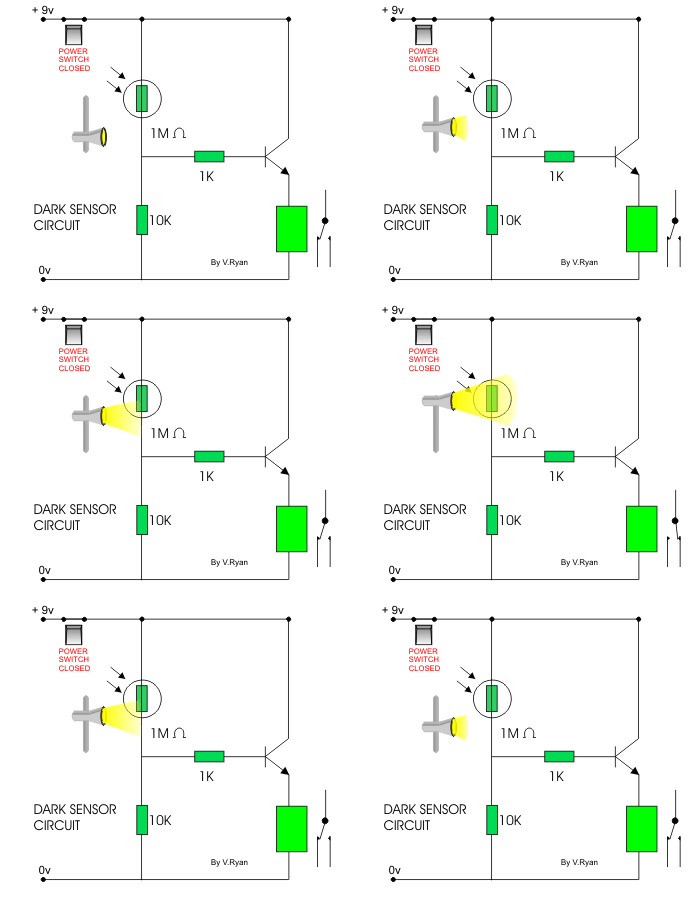
Opposite is a simple light/ dark sensor. This can be connected as an input or switch to another circuit. The sensors has three green wires (1, 2 and 3). Wire 2 should always be connected to one of the inputs. If wire 1 is also connected then the sensor acts as a dark sensor. If wires 2 and 3 are connected to the inputs then sensor operates as a light sensor.The preset resistor allows the person using the circuit to alter its sensitivity to light/dark.


CONSTRUCTING A CIRCUIT USING SIMULATION SOFTWARE
   
All circuits are drawn on software such as Crocodile Clips. Using this software the individual components can be joined together on the screen. Once the circuit is drawn its operation can be simulated to see if it works. If it fails it can be corrected on the computer screen and tested again.
Using software to test circuit designs saves time as there is no need to physically solder together components. It also saves money as components and materials are not wasted on failed circuits
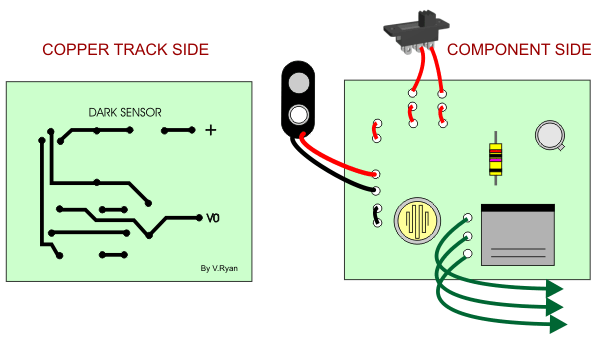
The circuit is then made into a PCB (Printed Circuit Board). Components are added and soldered in position (See PCB Section of this website). Two views of the same circuit are shown below. How do they differ?


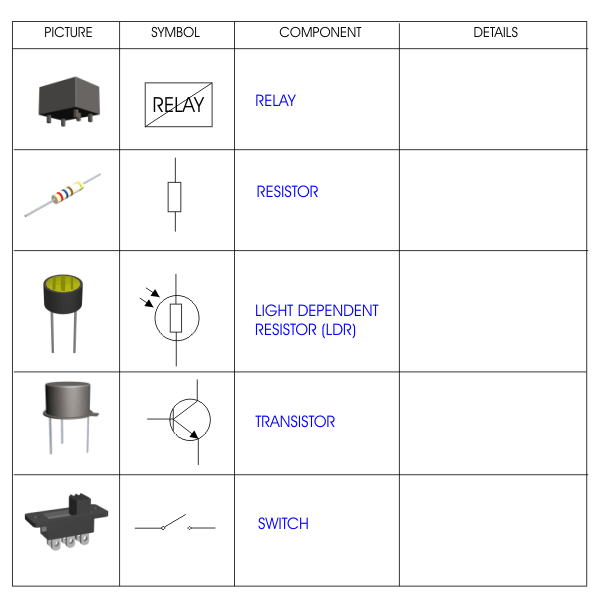
3. Complete the table below by writing some details about the components used in the light/dark sensor circuit.


Do you have any query or doubts,want to know that PLEASE ask it or leave your ideas at comment..or Just mail me:

MAil Me Your Query or Comments::

Friends,If you find anything incorrect here,PLEASE just inform me,to rectifies it !!!!!!!
Read More

Parallel Circuits n Working with examples

Parallel Circuits given in simple easy to understand format,if u have any other questions ask me via comment,r mail.

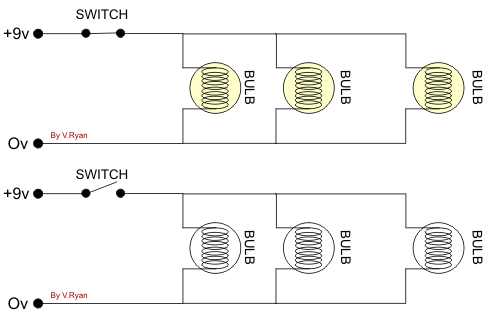
The circuit below shows three bulbs placed in parallel. This is a parallel circuit. Current can flow through each of the bulbs without first having to flow through any others. If any of the bulbs fail the others will still work as current can still flow through the rest of the circuit.


 ANOTHER PARALLEL CIRCUIT


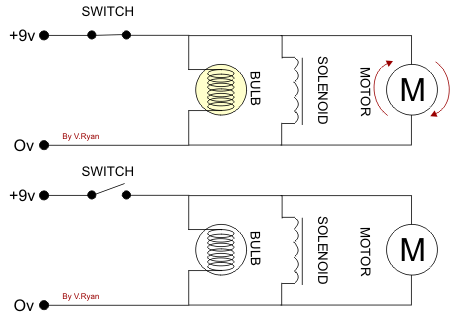
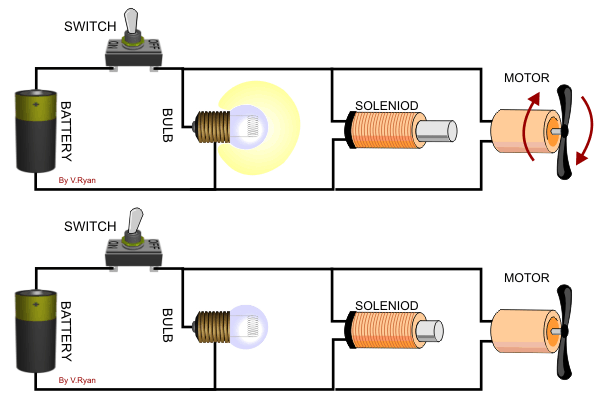
The circuit below is another example of a parallel circuit. When the switch is turned on current flows through the bulb, solenoid and motor simultaneously. This causes the bulb to light, the solenoid to the activated and the motors spindle to rotate, all at the same time.


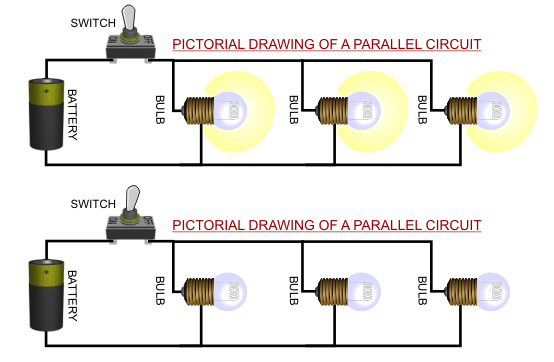
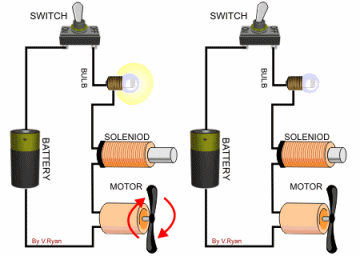
PICTORIAL DRAWING OF THE SAME PARALLEL CIRCUIT DIAGRAM


Crocodile Technology © software is very useful when simulating this type of circuit diagram.


Also see how Series Circuits works

QUESTIONS:
1. Draw a simple parallel circuit and explain how it works.
2. Draw the same components but this time arranged as a ‘series’ circuit. How do the two circuits differ?
3. What will happen if one of the components fails in a parallel circuit?


Can u answer for those questions? else reply via comments.

Do you have any query or doubts,want to know that PLEASE ask it or leave your ideas at comment..or Just mail me:

MAil Me Your Query or Comments::

Friends,If you find anything incorrect here,PLEASE just inform me,to rectifies it !!!!!!!
Read More

Series Circuits and How it works with examples

Series Circuits and its working in simple easy to understand format.        


The circuit opposite shows three bulbs placed in series. This is a called a series circuit. Current flows through each of the bulbs in sequence. Current flows through bulb A, then bulb B and finally bulb C. The more bulbs that are added, the less bright they shine. It is possible to added so many bulbs that they do not light at all. This is due to the resistance in each bulb. If any of the bulbs fail, current cannot flow through the circuit and the other components will not work.


ANOTHER SERIES CIRCUIT DIAGRAM


The circuit (right and left) is another example of a series circuit. When the switch is turned on current flows through the bulb first, then the solenoid and last the motor. This causes the bulb to light, the solenoid to be activated and the motor’s spindle to rotate. However, the more components that are added in series means the less current is available for all. Eventually, each component will fail to work as too much current is being drained from the circuit.


Do you have any query or doubts,want to know that PLEASE ask it or leave your ideas at comment..or Just mail me:

MAil Me Your Query or Comments::

Friends,If you find anything incorrect here,PLEASE just inform me,to rectifies it !!!!!!!
Read More

How Incandescent Lamps works in gif-1

Bulbs have been used in electronics for along time and they are used in a wide range of circuits. Almost everyone has used a torch and if you look closely at the light source, it is more than likely that it is a bulb. In more recent years bulbs have been slowly replaced by LEDs as these are brighter, much more reliable, cheaper, energy efficient and have a much longer working life. They are also available in a range of colours. However, bulbs are still popular.


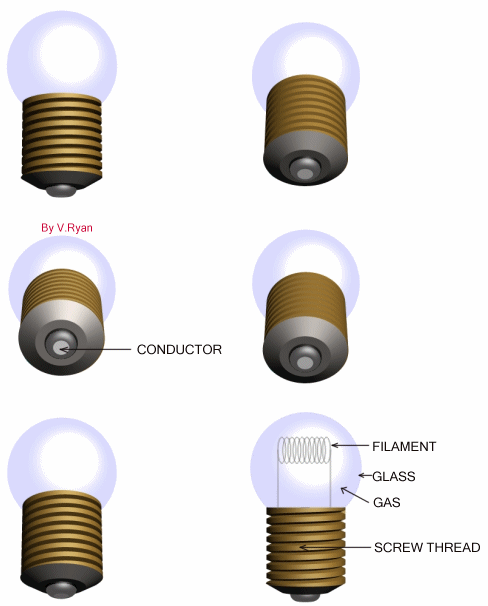
Look closely at a typical torch bulb. It basically consists of glass ‘bulb’, inside which is a filament made from a metal called tungsten. The glass bulb holds a gas called Argon or Nitrogen or Krypton, which increases the working life of the filament.
When current passes through the filament it illuminates brightly, giving out bright light.

Some bulbs such as the example opposite have a screw thread which means the bulb can be unscrewed from its holder and replaced, once the filament fails.

The ‘conductor’ at the bottom of this example bulb carries the current, allowing it to pass through the filament.

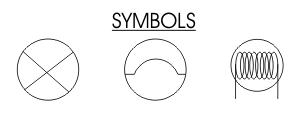
A number of symbols can be used to represent a bulb. Three typical symbols are shown opposite. These are often seen in examinations and consequently it is important to know them.
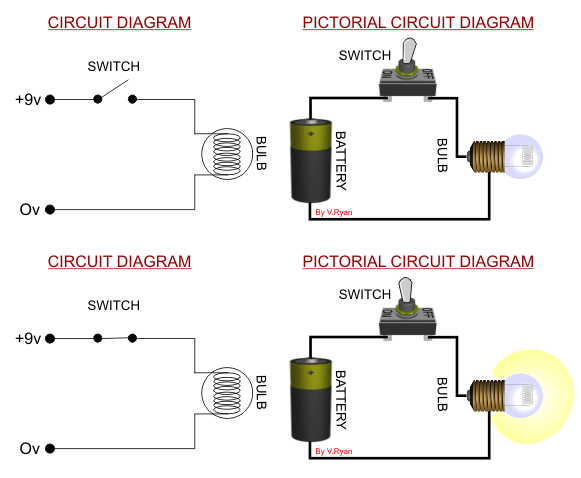

Two versions of the same circuit are shown below. The conventional circuit diagram (on the left) shows the filament bulb lighting brightly when the switch is turned on. The current flows through the filament, causing light to be emitted.
In the pictorial circuit diagram on the right the components are shown as pictures rather than symbols.


This basic circuit has a battery as the electrical ‘source’ and a filament bulb. The bulb is called the ‘load’ as it does all the work in the circuit (ie. it lights).


Do you have any query or doubts,want to know that PLEASE ask it or leave your ideas at comment..or Just mail me:

MAil Me Your Query or Comments::

Friends,If you find anything incorrect here,PLEASE just inform me,to rectifies it !!!!!!!
Read More

Switches and its working in gif-3


Some common switches are shown on this information sheet. Basically switches bring contacts together in different ways but they do the same switching job.
   
Typical Switch Symbols


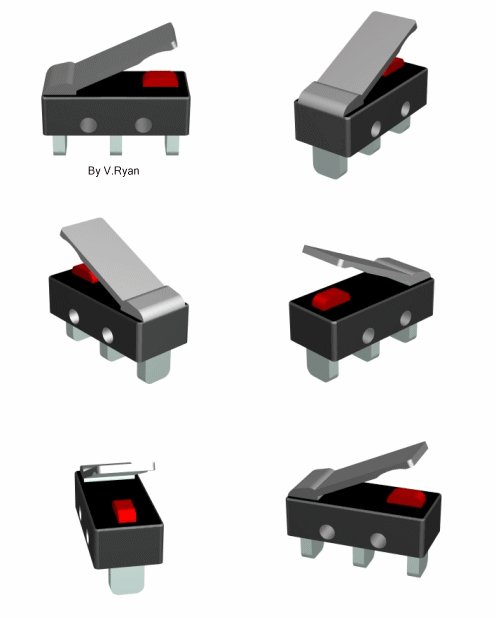
MICRO-SWITCH
 
Micro-switches can be very small. Usually they include a small arm which when pressed clicks. They are very useful and can be found on many machines - used a safety switches. For example, if the 'lid' of a drilling machine is opened to change the pulley speeds, a micro-switch is released ensuring that all power is turned off. These switches can be very useful in school projects


TILT SWITCH
 
One of the most common types of tilt switch uses a ‘blob’ of mercury in a small tube. When the tube is tilted the mercury runs down and forms a bridge across the two contacts turning the switch on. This type of switch is used in warning systems that alert people to an excessive angle of tilt, e.g. for drivers of farm vehicles.


PRESSURE PAD / SWITCH
 
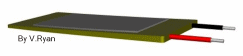
This is a soft flexible switch available in many sizes. It consists of two flexible conductive foil sheets separated by a thin felt, paper or foam layer. If pressure is applied the conductive surfaces touch and the switch is ‘on’


Do you have any query or doubts,want to know that PLEASE ask it or leave your ideas at comment..or Just mail me:

MAil Me Your Query or Comments::

Friends,If you find anything incorrect here,PLEASE just inform me,to rectifies it !!!!!!!
Read More

Switches and its working in gif-2


Some common switches are shown on this information sheet. Basically switches bring contacts together in different ways but they do the same switching job.
   
Typical Switch Symbols


TOGGLE SWITCH
 
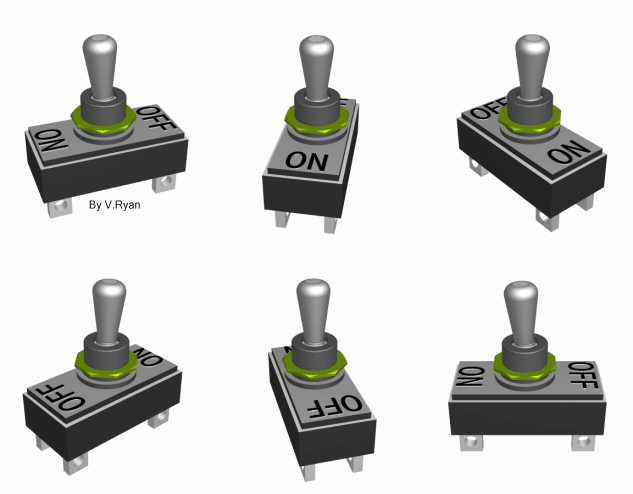
These are available in miniature and standard sizes. The advantage of the toggle switch is that they can be extended and operated by a lever.

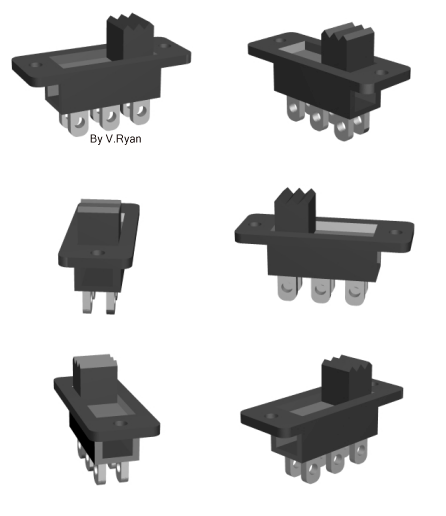
SLIDE SWITCH
 
Can be stiff to operate and does not operate smoothly. Available in a range of sizes.


REED / MAGNETIC SWITCH
 
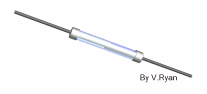
This is a thin glass tube that contains two thin strips of metal (the reeds). When a magnet is brought close to the glass tube, the reeds move together and make contact and the switch is turned on. The reeds open again when the magnet is removed. Reed switches are common in alarm systems, for example, in door frames. When the door is closed the magnet keeps the switch on. When the door is opened the alarm system senses the broken contact and goes off.
The top animation shows the reed switch with its glass 'surrounding' tube. The animation below shows the reed switch with the glass removed so that the two metal strips can be seen.


Do you have any query or doubts,want to know that PLEASE ask it or leave your ideas at comment..or Just mail me:

MAil Me Your Query or Comments::

Friends,If you find anything incorrect here,PLEASE just inform me,to rectifies it !!!!!!!
Read More

Know How Battery and led working

Many pupils are scared of electronics as they look at the books in the library. These are often very complex as very few have been written for beginners. This can put off people from learning about electronics and circuits. Everywhere we look there are examples of electronics, ranging from a simple radio to a hi-tech digital television. However complex looking an electronic device may be, they are all based on simple components gathered together in circuits.

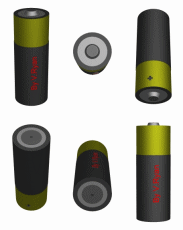
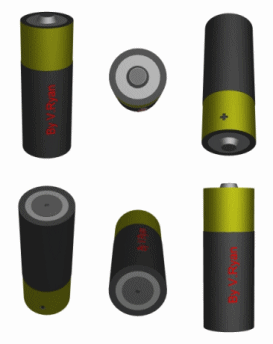
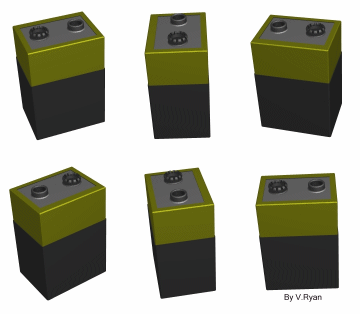
 Batteries come in all shapes and sizes. They store electrical charge and as we all know when they are put into an electronic device such as a portable radio, they provide the power. The usual battery sizes are seen opposite. These are the type used in school projects and range from 1.5 volts to 9 volts.
School projects are powered by batteries because they are safe, easily bought and safe.


QUESTION
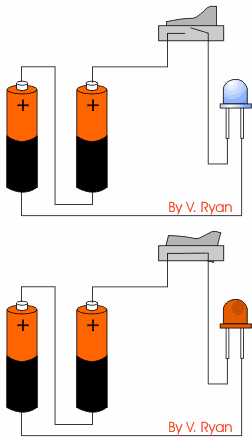
This shows one of the most simple circuits. When the switch is pressed, the LED (further information below) lights. Resistors are used in circuits because LEDs can be destroyed by voltages over 3 volts. Why do you think the circuit opposite does not have a resistor to protect the LED ?


ANSWER
Each battery is 1.5 volts. The two batteries are connected in ‘series’, they are both linked positive to negative and this gives us a total of 3 volts. Therefore, the LED is safe from damage.


THE LED


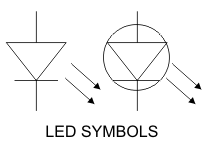
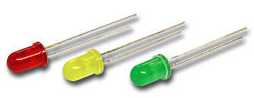
Light Emitting Diodes (LED) are very rugged, they last a very long time and they are an optical source. (A LIGHT SOURCE)
LEDs produce red, green, yellow, or orange light. They are used in a range of products. Can you name any ?
Infrared LEDs are also available although light from this type cannot be seen by the human eye. These are used in security devices.
LEDs are part of the diode family, consequently they must be connected the right way round or current will not pass through. They are usually protected by a resistor. (See DIODE information sheet).


A SELECTION OF THE MOST POPULAR COLOURS
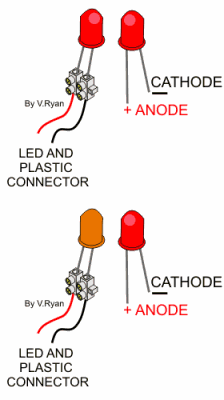
ENLARGED LED - NOTICE THE LONG AND SHORT LEG


Also Know How Swiches Works

Do you have any query or doubts,want to know that PLEASE ask it or leave your ideas at comment..or Just mail me:

MAil Me Your Query or Comments::

Friends,If you find anything incorrect here,PLEASE just inform me,to rectifies it !!!!!!!
Read More

Saturday, March 6, 2010

Working Of Semiconductors

0 comments
Semiconductors have had a monumental impact on our society. You find semiconductors at the heart of microprocessor chips as well as transistors. Anything that's computerized or uses radio waves depends on semiconductors.

Today, most semiconductor chips and transistors are created with silicon. You may have heard expressions like "Silicon Valley" and the "silicon economy," and that's why -- silicon is the heart of any electronic device.

A diode is the simplest possible semiconductor device, and is therefore an excellent beginning point if you want to understand how semiconductors work. In this article, you'll learn what a semiconductor is, how doping works and how a diode can be created using semiconductors. But first, let's take a close look at silicon.

Silicon is a very common element -- for example, it is the main element in sand and quartz. If you look "silicon" up in the periodic table, you will find that it sits next to aluminum, below carbon and above germanium.

Silicon sits next to aluminum and below carbon in the periodic table.


Carbon, silicon and germanium (germanium, like silicon, is also a semiconductor) have a unique property in their electron structure -- each has four electrons in its outer orbital. This allows them to form nice crystals. The four electrons form perfect covalent bonds with four neighboring atoms, creating a lattice. In carbon, we know the crystalline form as diamond. In silicon, the crystalline form is a silvery, metallic-looking substance.

In a silicon lattice, all silicon atoms bond perfectly to four neighbors, leaving no free electrons to conduct electric current. This makes a silicon crystal an insulator rather than a conductor.


Metals tend to be good conductors of electricity because they usually have "free electrons" that can move easily between atoms, and electricity involves the flow of electrons. While silicon crystals look metallic, they are not, in fact, metals. All of the outer electrons in a silicon crystal are involved in perfect covalent bonds, so they can't move around. A pure silicon crystal is nearly an insulator -- very little electricity will flow through it.

But you can change all this through a process called doping.
Read More

Working Of Amplifier

0 comments
When people refer to "amplifiers," they're usually talking about stereo components or musical equipment. But this is only a small representation of the spectrum of audio amplifiers. There are actually amplifiers all around us. You'll find them in televisions, computers, portable CD players and most other devices that use a speaker to produce sound.

Sound is a fascinating phenomenon. When something vibrates in the atmosphere, it moves the air particles around it. Those air particles in turn move the air particles around them, carrying the pulse of the vibration through the air. Our ears pick up these fluctuations in air pressure and translate them into electrical signals the brain can process.


Electronic sound equipment works the same basic way. It represents sound as a varying electric current. Broadly speaking, there are three steps in this sort of sound reproduction:
Sound waves move a microphone diaphragm back and forth, and the microphone translates this movement into an electrical signal. The electrical signal fluctuates to represent the compressions and rarefactions of the sound wave.

A recorder encodes this electrical signal as a pattern in some sort of medium -- as magnetic impulses on tape, for example, or as grooves in a record.

A player (such as a tape deck) re-interprets this pattern as an electrical signal and uses this electricity to move a speaker cone back and forth. This re-creates the air-pressure fluctuations originally recorded by the microphone.
As you can see, all the major components in this system are essentially translators: They take the signal in one form and put it into another. In the end, the sound signal is translated back into its original form, a physical sound wave.


In order to register all of the minute pressure fluctuations in a sound wave, the microphone diaphragm has to be extremely sensitive. This means it is very thin and moves only a short distance. Consequently, the microphone produces a fairly small electrical current.

This is fine for most of the stages in the process -- it's strong enough for use in the recorder, for example, and it is easily transmitted through wires. But the final step in the process -- pushing the speaker cone back and forth -- is more difficult. To do this, you need to boost the audio signal so it has a larger current while preserving the same pattern of charge fluctuation.

This is the job of the amplifier. It simply produces a more powerful version of the audio signal. In this article, we'll see what amplifiers do and how they do it. Amplifiers can be very complex devices, with hundreds of tiny pieces, but you can get a clear picture of how an amplifier works by examining the most basic components. In this next section, we'll look at the basic elements of amplifiers.
Read More